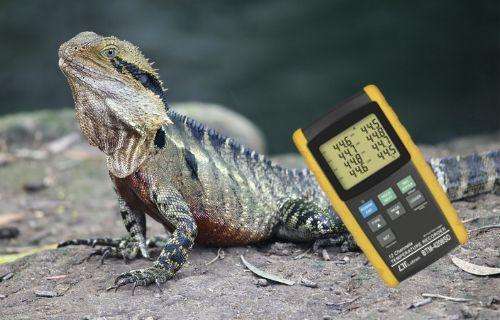
Using the Lutron BTM-4208SD in Reptile Research
It is generally understood that Australia has more lizard species than almost anywhere else on Earth. Nearly all of them depend on the sun to stay warm. So, scientists studying climate change are paying close attention to how rising temperatures affect our reptiles.
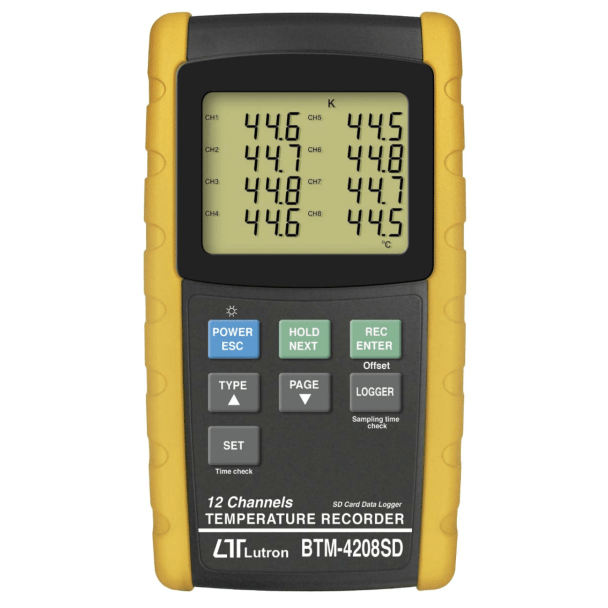
We recently heard from a researcher from one of Australia’s universities, who is studying how global warming affects lizard populations. They asked about a 12-channel temperature logging setup built around the Lutron BTM-4208SD 12-channel temperature recorder. It's a good example of how such an instrument can do serious work in field biology.
View BTM-4208SD Specifications
Why temperature matters so much to lizards
Lizards are ectotherms. Their body temperature comes mostly from their surroundings, not from their own metabolism. They manage their temperature by doing what they do: basking on rocks, shuttling between sun and shade, or retreating into burrows.
This means small changes in the environment can have big effects. When temperatures rise, lizards may:
spend more of the day sheltering and less time foraging or finding mates
move beyond their preferred body temperature into stressful ranges
have their growth, reproduction and survival affected over time
To understand these effects, researchers need accurate, continuous temperature data, often from many points at once. That means the lizard's skin, the ground it sits on, the shade nearby, and the air around it.
The measurement challenge
Measuring the temperature of a small reptile is harder than it sounds. The probes need to be:
Fine and flexible. They must rest gently against delicate skin without injuring the animal or changing its behaviour.
Fast to respond. A thin probe has very little mass, so it follows temperature changes quickly.
Long enough. It helps if the logger can sit a little way from the animal or enclosure.
Numerous. Comparing animals, microhabitats or treatments means recording many channels at the same time.
That's why the enquiry specified 12 fine-wire Type K thermocouple probes, each 2 metres long. Rigid insertion probes were not needed.
Why the BTM-4208SD suits this work
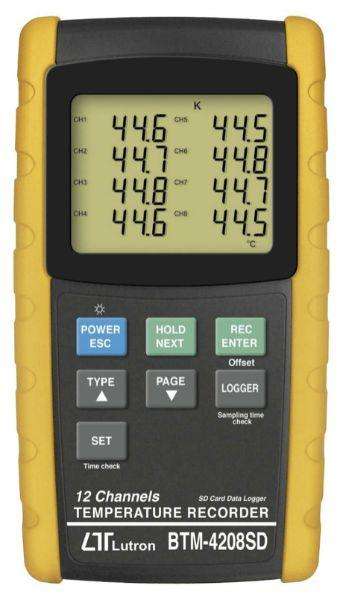
The Lutron BTM-4208SD is a 12-channel thermocouple thermometer with a built-in SD card datalogger. For a study like this, its main strengths are:
12 channels in one instrument. Up to 12 probes can be monitored and logged together, all on the same time base. You could cover several animals, or one animal plus its surroundings.
Several thermocouple types. It accepts Type K, J, T, E, R and S. Type K is a common all-round choice with a wide range and low-cost probes.
Stand-alone logging to SD card. Readings are saved with the date and time as spreadsheet-ready files. No laptop needs to stay connected, which helps in the lab and in the field.
Adjustable sampling rate. Researchers can take quick readings during short trials, or log slowly to capture daily cycles over long periods.
Portable. It's a hand-held-sized unit that runs on batteries or mains power, so it can move between the lab bench, outdoor enclosures and field sites.
A typical setup
A study using this setup might look like this:
Probe placement. Fine-wire Type K probes are gently attached to the skin of each study animal. Others are placed at basking sites, in shelters, in the soil and in open air.
Logging. The BTM-4208SD records all 12 channels at a set interval and writes the data to the SD card.
Analysis. The data goes into spreadsheet or statistics software, where body temperatures can be compared with environmental conditions. Researchers can then model how lizards might cope as heat events become more frequent and more intense.
Supporting Australian research
Instruments like the BTM-4208SD are usually found in HVAC commissioning, food safety and industrial process monitoring. It's good to see the same tools helping to answer important questions about Australia's biodiversity in a changing climate.
If you're a researcher, student or lab manager planning a temperature study, our team can help you choose a logger and the right probes for your application, including fine-wire probes for delicate surfaces. Contact our sales team for further details.