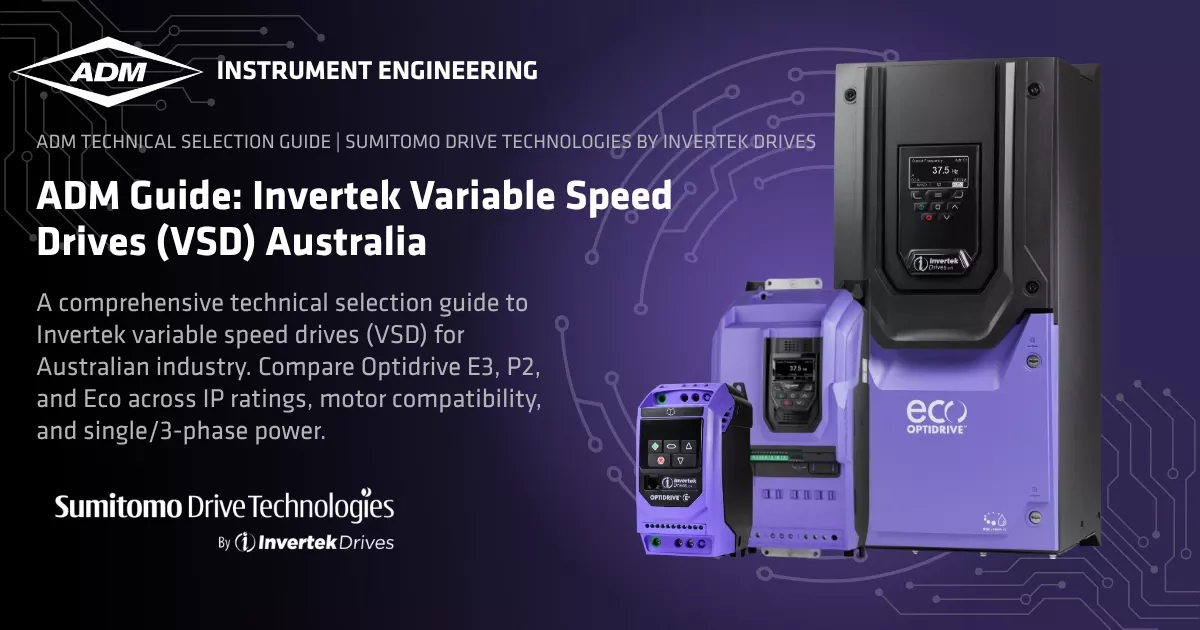
ADM Technical Guide: Invertek Variable Speed Drives (VSD) Australia
For support in finding the right Variable Speed Drive for your intended applications, call the ADM team on 1300 236 467 or send questions via our contact page here.
Core Drive Architectures
Selecting the right drive architecture depends on load dynamics: variable-torque loads (pumps and fans) require speed-optimised algorithms, while high-inertia, constant-torque loads demand high breakaway torque and dynamic vector control.
Optidrive E3: General Purpose Control
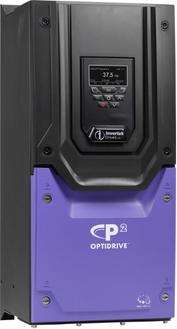
Optidrive P2: High-Performance Industrial
Optidrive Eco: HVAC & Municipal Water
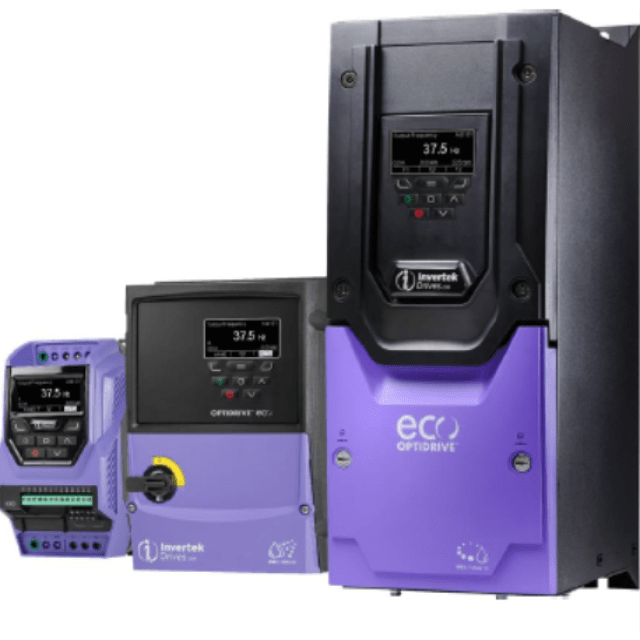
Explore the Invertek range on our Invertek supplier page.
Invertek VSD Series Comparison Matrix
Specification / Feature | Optidrive E3 | Optidrive P2 | Optidrive Eco |
Power Output Range | 0.37kW – 37kW | 0.75kW – 250kW | 0.75kW – 250kW |
Overload Capacity | 150% for 60s, 175% for 2s | 150% for 60s, 200% for 4s | 110% for 60s (normal duty) |
Control Modes | V/f, Sensorless Vector | 3GV Vector, Closed Loop Flux Vector | Energy Optimised V/f, Eco Vector |
Motor Compatibility | Induction, PM, BLDC, SynRM | Induction, PM, BLDC, SynRM | Induction, PM, SynRM |
Functional Safety | Optional external relay | Integrated STO (SIL2 / PLd) | Integrated STO (SIL2 / PLd) |
Built-in Fieldbus | Modbus RTU, CANopen | Modbus RTU, CANopen | BACnet MS/TP, Modbus RTU |
Electrical Infrastructure & Phase Compatibility
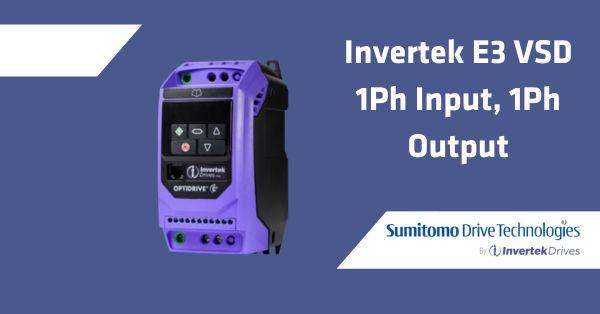
Single-Phase Input to Single-Phase Output (0.37kW – 1.1kW)
Single-Phase Input to Three-Phase Output (0.37kW – 4kW)
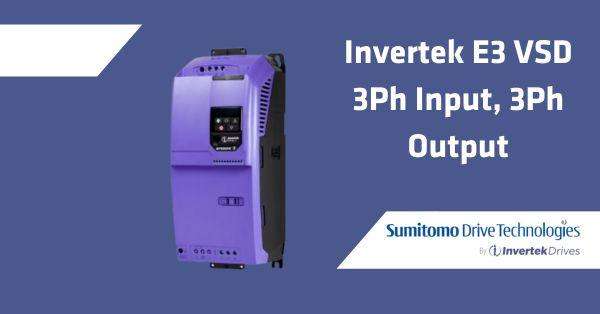
Three-Phase Industrial Supply (0.37kW – 250kW)
Enclosure Selection & Harsh Environment Protection
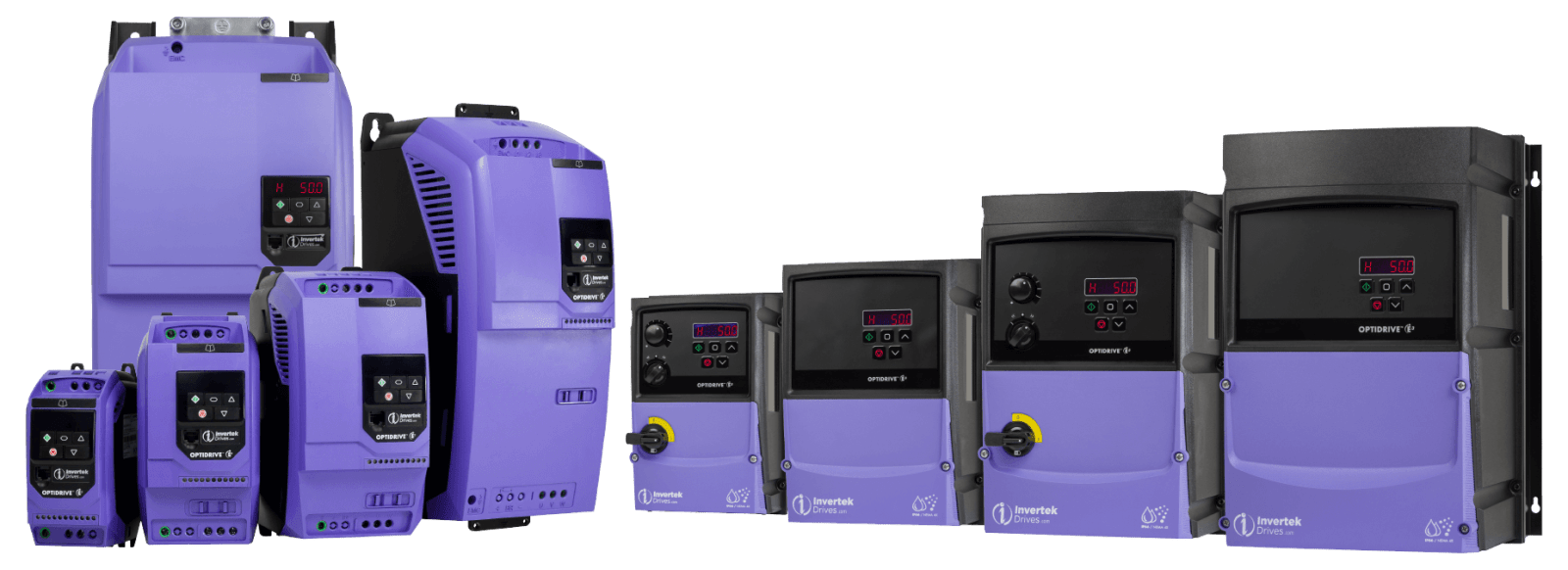
IP20 Enclosures
- Compact chassis units intended for installation inside centralised switchboards and climate-controlled motor control centres (MCCs).
IP55 / NEMA 12 Units
- Sealed against dust ingress and low-pressure water sprays. Suitable for wall-mounting inside pump stations and HVAC plant rooms without secondary electrical cabinets.
IP66 / NEMA 4X Units
- Sealed in UV-stabilised, chemically inert polycarbonate housings. Rated for -20°C to +50°C and resistant to high-pressure washdowns (up to 100 bar), making them suitable for direct field-mounting on outdoor conveyors, wash bays, and quarries.
Marine & Extreme Duty Ratings
Advanced Control, Communications & Safety
Fieldbus Networking: CANopen & Master-Slave
Master-Slave RS485 Bus
- Synchronises up to 63 drives across an RJ45 serial link to share real-time speed, torque, and operational status. Ideal for multi-motor conveyors and quarry extraction banks. Learn more about Master-Slave operations of the Invertek Optidrive P2 here.
CANopen Architecture
- Provides sub-millisecond process data exchange (PDO/SDO mapping) for coordinated industrial machinery. Learn more in our guide for using CANopen protocol to interface with Invertek Optidrive P2 Variable Speed Drives.
Embedded Logic & Modern Motor Retrofitting
Onboard PLC Functionality
- Optidrive P2 drives include an onboard PLC programmed using OptiTools Studio. Users can develop function-block logic, digital I/O routines, and simulated logic without an external micro-PLC. Read more on our blog: Designing a PLC program using the OptiTools Studio for Invertek VSDs.
PM & BLDC Motor Retrofits
- Upgrading legacy induction motors to permanent magnet or brushless DC variants requires high-frequency pulse-width modulation (up to 16kHz switching) and back-EMF parameter tuning to maintain motor stability. Read more on our blog, optimising Retrofit Applications with Invertek Drives for Permanent Magnet and Brushless DC motors.
Solar Off-Grid Pumping
- For remote installations, the Optidrive P2 Solar Pump system integrates an internal Maximum Power Point Tracking (MPPT) algorithm with dual-supply DC/AC switching for continuous agricultural irrigation. Read more on our blog: Invertek P2 Solar Pump Variable Speed Drive – Water Pumping in Remote Off-Grid Applications.
Commissioning, Diagnostics & Troubleshooting
Installation Best Practices
Systematic Commissioning Checklist
- Insulation Resistance: Disconnect drive terminals before motor megger testing to prevent output bridge damage.
- Phase Rotation & Earth Continuity: Verify low-impedance grounding paths to the single-point star earth.
- Motor Nameplate Entry: Enter accurate motor FLC, base frequency, RPM, and cos $\phi$.
- Rotational Autotune: Perform an uncoupled autotune to map stator resistance and inductive reactance accurately. Read our checklist in our blog: 10 things to check before commissioning an Invertek Variable Speed Drive.
Common Diagnostics & Fault Codes
Fault Code | Primary Cause | Immediate Remediation |
O-I (Overcurrent) | Mechanical jam, rapid acceleration ramp, or short circuit. | Check motor wiring insulation; extend acceleration-ramp time ($P-01$); inspect the mechanical load. |
O-U (Overvoltage) | High regenerative energy from deceleration. | Extend deceleration ramp time ($P-02$); install an external braking resistor and verify chopper activation. |
U-t (Under Temperature) | Ambient drive temperature dropped below -20°C. | Verify enclosure heating systems; check internal thermistor connections. |
SAFE-t (STO Fault) | STO circuit input loop open or miswired. | Check dual channel 24V DC safety circuit continuity; check emergency stop contacts. |
Frequently Asked Questions
Can an Invertek VSD run a standard 3-phase motor using single-phase mains power?
What is the advantage of mounting an IP66 VSD directly on equipment instead of an electrical cabinet?
How does Invertek Fire Mode work during a life-safety building emergency?
What is 3GV sensorless vector control on the Optidrive P2?
Need Technical Support? Call us Today!
Need engineering advice on sizing or deploying an Invertek variable speed drive for your site
Speak with the team about your motor control requirements, request technical data sheets, or arrange a commercial quote. Call the team on 1300 236 467 or send any questions to our contact page here.